Anselmi Mierzejewski Ruth & Sowle P.C.Michigan Insurance Defense Lawyer | Bloomfield Hills Automobile Negligence2026-08-27T21:12:07Zhttps://www.a-mlaw.com/feed/atom/WordPress/wp-content/uploads/sites/1604467/2022/03/cropped-site-identity-32x32.pngOn Behalf of Anselmi Mierzejewski Ruth & Sowle P.C.<![CDATA[LABSER PLC, NORTHLAND RADIOLOGY INC, JOSHUA SIMPSON -V- FARMERS INSURANCE EXCHANGE]]>https://www.a-mlaw.com/?p=2568892026-08-11T03:21:48Z2026-08-11T03:21:48Z
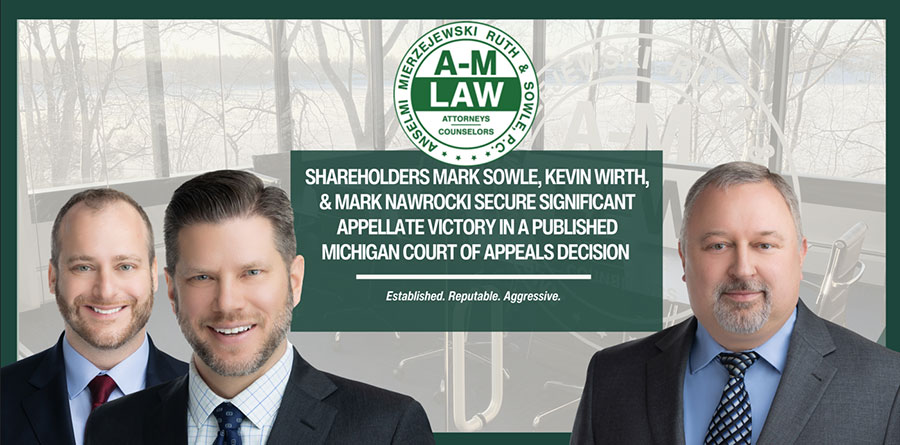
Anselmi Mierzejewski Ruth & Sowle, PC pursued a multifaceted appellate strategy, a/k/a “full court press” in a pivotal case before the Michigan Court of Appeals. In the published case of Labser v Farmers Insurance Exchange, (COA docket 373765, August 5, 2026) Joshua Simpson was operating an uninsured 2009 Dodge Journey (“vehicle”) and was involved in a motor vehicle accident. The vehicle was titled to Simpson’s fiancée. As a result of the accident, Simpson sustained injuries and obtained medical treatment at Labser and Northland Radiology. Thereafter, Simpson filed a claim with the MAIPF, which assigned the matter to Farmers Insurance Exchange.
In Simpson’s own first-party case, the Wayne County Circuit Court granted Farmers’ dispositive motion. Farmers argued that Simpson was barred from receiving no-fault benefits as he was a constructive owner of an uninsured vehicle, pursuant to MCL 500.3113(b). The trial court agreed, granted the dispositive motion and dismissed Farmers from the case.
Additionally, Labser and Northland Radiology filed a lawsuit against the MAIPF in Oakland County Circuit Court for reimbursement of no-fault benefits, pursuant to MCL 500.3112. Shareholder, Kevin Wirth represented Farmers, which was substituted in place of the MAIPF. Farmers filed its dispositive motion arguing that Simpson was a constructive owner of the involved, uninsured vehicle and as a result was barred from no-fault benefits pursuant to Sec. 3113(b) and as a result Plaintiffs’ cause of action is likewise barred as there is no valid underlying claim covered by PIP benefits. The trial court adopted Plaintiff’s argument and found that Simpson did not possess a lease agreement, contract of sale, or other documentation that created a vested possessory interest in the vehicle for greater than 30 days and denied the motion finding that Simpson was not a constructive owner of the involved vehicle.
After considerable supplemental briefing regarding Farmers’ motion for reconsideration concerning constructive ownership and specifically the application of Mota-Peguero v Falls Lake Nat’l Ins Co, 350 Mich App 692 (2024), the trial court granted Farmers’ motion for reconsideration. The trial court found Simpson to be a constructive owner of the uninsured, involved vehicle and was barred from benefits. Furthermore, it held that while Sec. 3112 allows a medical provider to initiate its own case for payment, the insurer was not responsible for payment when the underlying claimant did not qualify for benefits. The trial distinguished Mota-Peguero from the instant case, reversed its prior decision, and granted Farmers’ motion for reconsideration. Plaintiff appealed.
On Appeal, the Plaintiff argued that the trial court erred when it found that Simpson was not a constructive owner of the involved vehicle and that a medical provider can maintain a cause of action pursuant to Sec. 3112, regardless if the underlying claimant, Simpson, was eligible for no-fault benefits. Shareholder Kevin Wirth successfully guided the matter through circuit court, with Shareholder Mark Nawrocki preparing the appellate briefs, while A-M President/Shareholder, Mark Sowle handled the oral arguments for Farmers before the Court of Appeals.
As to the issue of constructive ownership, the Court affirmed the trial court’s holding that Simpson was a constructive owner of the involved, uninsured vehicle. The Court disagreed with Plaintiff’s argument that Simpson required permanent and exclusive right to use the vehicle for more than 30 days based on a written agreement between Simpson and his fiancée. The Court stated “[w]e find no grounds to read into this statutory language a written-agreement requirement.”
As to the issue of whether a medical provider can maintain a claim when the underlying claimant is barred, the Court affirmed the trial court’s ruling. The Court agreed that Sec. 3112 allows medical providers to bring a direct cause of action to recover PIP benefits. The Court distinguished Mota-Pegureo, which involved the post-collision recession of an insurance policy involving the balancing of the equities to determine if rescission between the medical provider and insurer is available. In this case, the claim was filed with the MAIPF, which issued no insurance policy requiring rescission or a balancing of the equities. (With an insurance policy, benefits are presumed/expected as an insurance premium is paid thus requiring Court approved rescission; however, the Legislature mandated that claimants with the MAIPF satisfy conditions precedent to be eligible and entitled to PIP benefits as there is no insurance policy or premium paid as it is funded by all insured drivers in Michigan).
The Court examined Sec. 3157, which states in relevant part “a physician, hospital, clinic, or other person that lawfully renders treatment to an injured person for an accidental bodily injury covered by personal protection insurance[.]” the Court found that while Simpson was injured, but he was not covered by personal protection insurance under the No-Fault Act as he was barred by Sec. 3113(b) as the owner of an uninsured vehicle involved in the accident.
The Court of Appeals delivered a big win to Farmers in this published case holding that Mota-Pegureo does not give providers a “free pass” when the claimant is ineligible. Importantly, because an ineligible claimant is not “covered by personal protection insurance” as required within MCL 500.3157, there is consequently no ability to maintain the provider’s MCL 500.3112 direct cause of action]]>On Behalf of Anselmi Mierzejewski Ruth & Sowle P.C.<![CDATA[Shareholder Mark L. Nawrocki Successfully Argues on Behalf of Citizens in Court of Appeals]]>https://www.a-mlaw.com/?p=2566622026-03-18T07:11:54Z2026-03-18T07:07:28Z
In the matter of Elias v Great American, et al., Court of Appeals Docket 370595, Shareholder, Mark Nawrocki of Anselmi Mierzejewski Ruth & Sowle, PC successfully argued on behalf of Citizens Insurance Company of the Midwest, the MACP assigned servicing insurer.
Plaintiff/Appellant, Kousay Elias was operating a semi-truck without a trailer (a/k/a/ bobtail semi) on northbound I-75, awaiting a telephone call from his employer to determine if he had another load to pick up or park the vehicle at the yard. The semi-truck was owned by LI Trucking, Michigan company, and registered and titled in Michigan and garaged in Warren, Michigan; however, it was leased to Hunter Express, which is a Texas Company and insured with a Texas policy through Knight Specialty Insurance Company. Great American Assurance Company provided bobtail coverage.
On January 18, 2020, due to icy conditions, Elias was operating the semi-truck and slid off the highway on to the shoulder. It was towed back on to the highway and Elias continued to drive the vehicle to the yard.
Just shy of a year later, Plaintiff’s attorney sent a letter to Great American Insurance Company regarding the claim. Two days later, on the one-year anniversary of the accident, Plaintiff’s attorney sent a letter to Trisura Specialty Insurance Company and Hunter Express. On the same day, an application for benefits was filed with the MAIPF. During the litigation, Plaintiff’s attorney stipulated to dismiss Great American and Trisura as Defendants.
Elias informed the MAIPF that he resided with his sister and brother-in-law at the time of the accident. Through discovery it was determined that Elias’s sister was insured with Progressive. MAIPF filed a third-party complaint against Progressive and Knight Specialty Insurance, seeking a declaration of rights and duties of the interested parties. MAIPF argued that Progressive was higher in priority pursuant to resident relative coverage under MCL 500.3114(1) and that Knight was higher in priority as it insured the employer furnished vehicle under MCL 500.3114(3). MAIPF also sought reformation of Knight’s Texas policy to provide Michigan No-Fault benefits. Thereafter, Elias amended his Complaint and added a count against Progressive and Knight.
The trial court reformed Knight’s policy to provide Michigan coverage. Thereafter, all parties filed dispositive motions. MAIPF argued there was higher priority insurance, Progressive argued that it did not receive notice within a year and Knight argued that it did not receive notice within a year and Elias was an independent contractor, thus Knight was not in the priority of insurance. All dispositive motions were all granted and the case dismissed. Elias appealed.
On appeal, Elias argued that Knight was not easily identifiable within a year, he made a good faith effort to notify responsible insurers, and that Citizens failed to pay the claim within 30 days. The Court of Appeals relied on Griffin v Trumbull, 509 Mich 484 (2002), and held that “Plaintiff did not exercise due diligence in attempting to identify them [Progressive and Knight] and notify them of his claims” and that they were both easily identifiable within a year of the accident. Because there was easily identifiable insurance, Elias could not proceed against Citizens/MAIPF pursuant to MCL 500.3172(1)(b). The Court stated that while there could have been a priority dispute between two insurers, Progressive and Knight, Elias did not exercise due diligence to timely notify either. For the same reason, the Court concluded that Citizens/MAIPF was not responsible to provide no-fault benefits. The Court of Appeals affirmed the trial court’s granting of summary disposition and concluded by stating that “Plaintiff is not eligible for benefits from any defendant or third-party defendant.”]]>On Behalf of Anselmi Mierzejewski Ruth & Sowle P.C.<![CDATA[Shareholder Lauren N. Brezenski and Attorney Morgan E. Walters obtained a favorable ruling in the Michigan Court of Appeals in Gales v ACIA]]>https://www.a-mlaw.com/?p=2565522025-11-20T06:33:38Z2025-11-20T06:32:54Z
Shareholder Lauren N. Brezenski and Attorney Morgan E. Walters obtained a favorable ruling in the Michigan Court of Appeals in Sheila Gales v ACIA, which addressed unlawfully taking under MCL 500.3113(a). In trial court proceedings, which took place in Wayne County Circuit Court, Plaintiff argued that she was entitled to no-fault benefits due to her reasonable belief that she was granted permission for the use of a vehicle, in spite of never having been expressly granted permission.
Attorney Walters skillfully deposed both Plaintiff and the vehicle owner and obtained testimony from both parties which affirmed Plaintiff had not been granted permissive use of the vehicle and that her use of the vehicle did constitute unlawful taking. Attorney Walters was granted summary disposition disqualifying Plaintiff from receiving no-fault benefits in the trial court. Plaintiff filed a Motion for Reconsideration pertaining to the standard for unlawful taking pursuant to MCL 500.3113(a), which was denied in the trial court.
Plaintiff filed an Appeal, and argued to the Michigan Court of Appeals that Plaintiff’s belief she had permission to use the vehicle precluded an unlawful taking argument. Shareholder Brezenski, with the assistance of Attorney Walters, established in the Court of Appeals that the 2015 reform of the aforementioned statute amended the scienter standard of the statute in expanding the scope of individuals who may be barred from receipt of no-fault benefits to include any person who “knew or should have known that the motor vehicle or motorcycle was taken unlawfully”. Moreover, Shareholder Brezenski used the deposition testimony relied upon in the trial court to establish once more that Plaintiff had never been given express permission to use the vehicle and thus, should have known she was not granted permissive use of the vehicle.
The Michigan Court of Appeals ultimately affirmed the lower court ruling in favor of the carrier; as such, Plaintiff was deemed ineligible for no-fault benefits and her claims were dismissed.
]]>On Behalf of Anselmi Mierzejewski Ruth & Sowle P.C.<![CDATA[Muzafer Isovska v Fitzpatrick, USAU, Progressive, MAIPF]]>https://www.a-mlaw.com/?p=2564582025-11-11T15:18:27Z2025-11-11T15:13:32Z
In the matter of Muzafer Isovska v Fitzpatrick, USAU, Progressive, MAIPF, Court of Appeals docket number 368902, published opinion (Oct. 30, 2025), Shareholder, Mark Nawrocki of Anselmi Mierzejewski Ruth & Sowle, PC successfully argued on behalf of the MAIPF.
Plaintiff was the named insured on a USAU policy for her Toyota Yaris. Plaintiff’s daughter, Brianna, owned a Ford Focus that was insured with Progressive. Plaintiff was also the registrant of the Ford Focus. Plaintiff was involved in a motor vehicle accident while operating the Ford Focus. Her claim with Progressive was denied as Progressive rescinded the policy, ab initio, due to Brianna failing to disclose that she lived with her mother/Plaintiff. Plaintiff’s claim with USAU was also denied for two reasons: 1) the Plaintiff was the registrant of the Ford Focus and it was not insured with USAU, and 2) the Plaintiff was the registrant of an uninsured vehicle involved in the motor vehicle accident as progressive rescinded its policy, Sec 3113(b).
Progressive argued that its policy should be rescinded due to the material misrepresentation in the application process. USAU argued that: 1) the Plaintiff was the registrant of the Ford Focus and it was not insured with USAU (policy Exclusion D), and 2) the Plaintiff was the registrant of an uninsured vehicle involved in the motor vehicle accident as Progressive rescinded its policy, Sec 3113(b) (policy exclusion E). MAIPF argued that Plaintiff either obtained coverage from Progressive based on a resident relative theory of Sec. 3114(1) or alternatively, that Plaintiff was the registrant of an uninsured vehicle, (Sec. 3113(b)). The trial court granted all of the Defendants filed dispositive motions and Plaintiff appealed.
Because Progressive wanted to rescind its policy, the Court of Appeals had to balance the equities as they applied to the Plaintiff as a third-party to the policy. The Court found that Progressive did not produce evidence to conclusively demonstrate that the Plaintiff was aware of the alleged fraud in the application and vacated the trial court’s order granting Progressive’s dispositive motion. The Court found that USAU policy exclusion “D” violated the No-Fault Act and was invalid. However, in dicta, as to USAU’s exclusion “E”, the Court examined the Michigan Supreme Court’s ruling in Wilmore-Moody v Sentinel Ins Co¸ 502 Mich 390 (2018) and concluded that rescission/voiding a policy ab-initio, is a legal fiction between the contracting parties and a third-party to that contract cannot rely on the rescission. As such, the rescission “does not alter reality or act as a DeLorean time machine” or “create an alternative reality.”
Despite the policy being rescinded ab-initio, the vehicle was insured at the time of the motor vehicle accident. The Court did not rule on the rescission issue as there were material facts in dispute surrounding Progressive’s rescission. The Court reversed the trial court’s granting of USAU’s dispositive motion as to PIP benefits. Lastly, as to MAIPF’s dispositive motion, the Court affirmed the trial court’s ruling as MAIPF correctly argued that either of its potential outcomes set forth in its Motion would preclude liability on the part of the MAIPF.
The Court affirmed the trial court’s granting of the MAIPF’s dispositive motion.]]>On Behalf of Anselmi Mierzejewski Ruth & Sowle P.C.<![CDATA[Aric Holloway v Memberselect, Citizens Insurance Company of the Midwest]]>https://www.a-mlaw.com/?p=2564552025-11-11T15:10:48Z2025-11-11T14:23:01Z
In the matter of Aric Holloway v Memberselect, Citizens Insurance Company of the Midwest, Court of Appeals Docket 367611, Shareholder Mark Nawrocki of Anselmi Mierzejewski Ruth & Sowle, PC successfully argued on behalf of Citizens in Plaintiff’s appeal.
Plaintiff/Appellant Aric Holloway was a passenger in a vehicle that was rear-ended and the driver of the other vehicle fled the scene on foot. As a result of the motor vehicle accident, Holloway filed a claim with the MAIPF and attested that the information contained therein was true and accurate. The MAIPF assigned this matter to Citizens. It was learned that during Discovery, Holloway made several false statements to Citizens regarding his claim. Those false statements included: 1) the address that he lived at the time of the motor vehicle accident, 2) identity of people in the household, 3) whether there were vehicles in the household, 4) whether there was insurance in the household, 5) replacement and attendant care calendars completed by an individual that did not know Holloway, and 6) claiming replacement and attendant care benefits for February 29, 30, and 31 in a non-leap year. Based on these facts, Citizens filed a dispositive motion to which Holloway responded arguing clerical errors and did not knowingly make a false statement which was granted by the trial court. Memberselect filed a dispositive motion arguing that Holloway’s father opted out of allowable expenses coverage, which was granted by the trial court.
Holloway appealed and initially relied upon the Court of Appeals decision in Williamson v AAA, which held that misrepresentations made during litigation did not constitute false statements under Sec 3173a(4). Holloways reliance on Williamson was moot as the Michigan Supreme Court reversed that decision. Holloway argued that his cognitive deficits prevented him from making a knowingly false statement, but the Court found there was no evidence to factually support this argument. Lastly, Holloways argued that there was a genuine issue of material fact in dispute as to his testimony and the testimony of the service provider. However the Court found this argument uncompelling.
Because Holloway appealed an order that was not a final order and the matter did not resolve until months after Citizens’ dispositive motion was granted, Citizens argued that the Court did not have jurisdiction as there was no express reservation of the right to appeal. Citizens relied on Sandoval v Farmers, that held an Appellant could not challenge an earlier order if it consented or stipulated to the final order, unless the stipulation allows an appeal, was moot as the Michigan Supreme Court reversed that decision finding an aggrieved party may raise on appeal issues arising from an earlier order relating to one party, even if a later, stipulated order of dismissal as to another party does not contain a reservation of the right to claim an appeal from the earlier order and concluded that this case was incorrectly decided.” Citizens presented the same factual misrepresentations as in the trial court and that knowingly providing a false statement does not include intent, which is an element of “fraud,” and is commonly the higher standard in cases involving an insurance policy.
The Court agreed and affirmed the trial court’s granting of MAIPF’s dispositive motion.]]>On Behalf of Anselmi Mierzejewski Ruth & Sowle P.C.<![CDATA[Anselmi Mierzejewski Ruth & Sowle, PC Proudly Presents at the Annual Insurance & the Law Conference]]>https://www.a-mlaw.com/?p=2564012025-10-03T08:01:15Z2025-10-03T07:50:58ZAM Law was honored to serve as a presenter at the Annual Insurance & the Law Conference, hosted by the Insurance Alliance of Michigan (IAM). This annual gathering brings together leading voices in law, insurance, and public policy to address some of the most pressing challenges and opportunities facing Michigan’s insurance industry.
About the Insurance Alliance of Michigan
The Insurance Alliance of Michigan is the leading advocate for property and casualty insurers across the state, representing companies both large and small. IAM serves as a trusted resource for policymakers, opinion leaders, and the media, ensuring that critical decisions are informed by data, expertise, and a deep understanding of the industry.Through its work, IAM plays a pivotal role in connecting decision-makers with the tools and knowledge they need to navigate a constantly evolving legal and regulatory environment.
AM Law’s Role
As part of this year’s conference, AM Law presented on key legal issues impacting the insurance sector. Our team provided insight into the evolving landscape of Insurance Law and Litigationand discussed strategies insurers can adopt to stay ahead of these challenges.The session sparked meaningful discussion among attendees and highlighted the importance of ongoing collaboration between the legal and insurance communities.
Why This Matters
Insurance plays a vital role in protecting Michigan families, businesses, and communities. By partnering with organizations like IAM and engaging in forums such as the Annual Insurance & the Law Conference, AM Law helps strengthen the industry’s ability to adapt, grow, and deliver.We are proud to contribute our knowledge and expertise to this important conversation and look forward to continuing our collaboration with IAM and industry leaders across the state.]]>On Behalf of Anselmi Mierzejewski Ruth & Sowle P.C.<![CDATA[Shareholder Mark L. Nawrocki Successfully Argues Appeal In Phase One Rehab, LLC V Allstate Insurance Company]]>https://www.a-mlaw.com/?p=2563252025-06-20T06:43:06Z2025-06-20T06:43:06Z
In the matter of Phase One Rehab, LLC v Allstate Insurance Company, Wayne County Circuit Case No. 25-000123-AV, Mark L. Nawrocki of Anselmi, Mierzejewski, Ruth & Sowle, successfully argued the Plaintiff/Appellant’s appeal from District Court to the Circuit Court. Allstate Insurance Company was the assigned servicing insurer of the Michigan Assigned Claims Plan, which is managed by the Michigan Automobile Insurance Placement Facility (“MAIPF”). The issue on appeal is whether a medical provider’s cause of action is derivative of an ineligible human claimant when the human claimant’s claim is barred due to knowingly providing false information pursuant to MCL 500.3173a(4).
In a separate, but related lawsuit, the human claimant brought his own claim for reimbursement of No-Fault benefits. Sec. 3173a(4) of the No-Fault Act, bars claim filed with the MAIPF when false information is knowingly provided to the MAIPF in support of the claim. It was learned during discovery, that the human claimant made numerous material misrepresentations regarding his claim. This resulted in his case being dismissed due to the trial court granting MAIPF’s dispositive motion on the issue.
Phase One Rehab, LLC filed a lawsuit for reimbursement of medical treatment allegedly provided to the human claimant in the District Court. Its lawsuit was dismissed by the trial court based upon MAIPF’s dispositive motion that the underlying claim was dismissed based upon numerous material misrepresentations.
Thereafter, Phase One Rehab, LLC appealed the matter to the Wayne Circuit Court arguing that the trial court erred when it granted MAIPF’s dispositive motion. In its brief, the Appellant medical provider argued that MCL 500.3112 provides it an independent right to bring and maintain a cause of action for reimbursement of No-Fault benefits. It argued that any material misrepresentation that may have rendered the human claimant ineligible for No-Fault benefits, did not extend to the medical provider as it has an independent cause of action. The Appellant conflated the issues of “the right to make a claim” with “the right to maintain a claim.”
In response, the Appellee/MAIPF argued that a claim filed with the MAIPF must satisfy certain conditions precedent prior to the claim being deemed eligible for benefits. Those conditions are; 1) provide timely notice, 2) submit an application for benefits, 3) provide contemporaneous, independent proof of loss, 4) appear for an examination under oath, if requested, 5) cooperate with the MAIPF investigation, and 6) do not submit false information concerning the claim. MCL 500.3173a. Because the underlying human claimant provided numerous material misrepresentations to the MAIPF, the claim was barred.
Applicable case law holds that a claim for certain benefits is part of – and not separate from – the claim that a person submits to the MAIPF, a request for a different benefit is not a new claim separate from the prior claim to the MAIPF. Regardless whether the misrepresentation was only to a certain benefit, the entire claim is barred. Also, the case law relied upon by the Appellant applied to cases where an insurer was rescinding a policy and clearly not applicable to the MAIPF where there is no policy. Additionally, Appellant’s argument that the insurer’s rescission did not automatically defeat the medical provider’s claim was distinguishable as the MAIPF did not argue that the medical provider’s claim is automatically dismissed, nor did the MAPF rely upon res judicata or collateral estoppel in its dispositive motion, nor was there a rescission of a policy. Instead the MAIPF set forth all facts and arguments as to why the claimant and Plaintiff/Appellant would be barred under Sec. 3173a(4).
Lastly, the MAIPF argued that the medical provider’s right to maintain a case is derivative upon there being a valid underlying claimant’s claim. The MAIPF relied upon the wording in statute and case law that held where PIP benefits are payable to or for the benefits of an injured person … and a medical provider can assert a direct cause of action to recover overdue benefits provided to an injured person. As such, there must be a valid underlying human claim for the medical providers to maintain its action. To argue otherwise is nonsensical and contrary to the statute and case law.
The Wayne County Circuit Court agreed with the Appellee/MAIPF and denied the Appellant’s appeal. The Court found that a medical provider cannot maintain a case against the MAIPF where the underlying human’s claim was found to be ineligible based on material misrepresentation.
Nothing in this post shall be construed as legal advice. If you would like any additional information, please feel free to reach out to Mr. Nawrocki.]]>On Behalf of Anselmi Mierzejewski Ruth & Sowle P.C.<![CDATA[American Physio, LLC v State Farm]]>https://www.a-mlaw.com/?p=2563232025-04-22T06:17:26Z2025-04-22T06:17:26ZAmerican Physio, LLC v State Farm, docket number 367918, Chris Endres of Anselmi, Mierzejewski, Ruth & Sowle, successfully argued in the Michigan Court of Appeals that an assigned claims insurer is not responsible for no-fault benefits when someone completely opts out of medical benefits/allowable expenses under MCL 500.3107d (Medicare/qualified health coverage).
The Court of Appeals held that anyone who could claim benefits under that policy - resident relatives and/or spouse of named insured - are not eligible for allowable expense no-fault benefits. The Court went on to find that the opt out policy is in the order of priority, so the claimant cannot satisfy any of the requirements of MCL 500.3172 and seek allowable expense benefits from an assigned insurer. This preclusion also extends to medical providers.
The statute is written in such a way that there are two potential outcomes when a claimant is a resident relative of an insured who has opted out of PIP/no-fault benefits - either they are subject to the opt out or the opt out was not proper (either the insured or a resident relative does not have qualified health coverage or Medicare). If the opt out was not proper then the policy converts to a full unlimited PIP policy. In either scenario, there is no exposure to the assigned carrier. This preclusion applies to the named insured, a spouse of the named insured, a resident relative of the named insured, and any providers seeking benefits on behalf of the claimant. An opt out policy is considered "personal protection insurance applicable to the injury." That precludes a claimant from claiming benefits from an assigned carrier. The opt out policy is priority under MCL 500.3114.
There is no obligation for an assigned carrier to pay and then litigate a dispute as to whether the opt out was proper or not. The Court of Appeals also reiterated that diligence is required in ascertaining the appropriate insurer. Nothing in this post shall be construed as legal advice.
If you would like any additional information, please feel free to reach out to Mr. Endres.]]>On Behalf of Anselmi Mierzejewski Ruth & Sowle P.C.<![CDATA[Michigan Supreme Court Ruling on Co-Owner Premises Liability Claims: A Summary of Janini v. London Townhouses Condominium Association]]>https://www.a-mlaw.com/?p=2561672024-07-19T04:43:50Z2024-07-19T04:36:55Z(Docket No. 164158)
Daoud Janini owned a unit at the London Townhouses Condominium complex. On March 16, 2019, while walking to throw out garbage, Janini slipped on a sidewalk covered in snow and ice while in the common area of the complex. Janini filed suit against the condominium association, alleging various claims, including most importantly and the sole issue in the Supreme Court’s decision, a claim for common law premises liability negligence.
In a 5-2 decision, the Supreme Court ultimately overturned a previous case, Francescutti v Fox Chase Condo Ass’n, 312 Mich App 640; 886 NW2d 891 (2015), based on the notion that a co-owner of a premises is not the person necessarily “in control” of the premises, and thus made a distinction between ownership of a premises and control of a premises. In support of this, the Supreme Court held that liability attaches in two important respects. First, the Supreme Court held that a unit owner in a condo association is an “invitee” of the association because unit owners have a business relationship with associations wherein they pay associations (in the form of HOA fees) for the ability to use common areas of the complex and for the association to take care of the common areas.
The Supreme Court also held that a “special relationship” existed between tenants and associations, and cited to Bailey v Schaaf, 494 Mich 595, 604; 835 NW2d 413 (2013) in support of its holding. The Supreme Court indicated that “special relationships are predicated on an imbalance of control, where one person entrusts himself to the control and protection of another, with a consequent loss of control to protect himself.” The Supreme Court held that this dynamic exists between unit owners and an association because unit owners “do not independently exercise exclusive ownership over the common elements . . . . Rather, condominium co-owners cede control over those common elements to the condominium association, and it becomes the responsibility of the condominium association to maintain those common elements.”
Aftermath
The Janini decision certainly opens condominium associations to more potential liability as it pertains to co-owners of the complexes. However, the Janini decision still leaves many questions unanswered. While the Supreme Court held that Francescutti was overturned, it is important to note that the Francescutti case examined additional issues that were not addressed in the Janini case, such as whether co-owners of a condo complex can additionally rely on MCL 554.139 as an additional cause of action on top of common law premises. It is expected that the “holes” created in Janini will result in these issues needing to be litigated in the future.
Author’s NoteAnthony P. Sinishtaj and Rita Arabo lead the Premises Liability department at Anselmi Mierzejewski Ruth & Sowle P.C. and conduct intake for these types of cases. If you have any questions or a legal issue that needs answering, please contact our firm for consultation.]]>On Behalf of Anselmi Mierzejewski Ruth & Sowle P.C.<![CDATA[After diligent work lasting over two years, AM Law has again prevailed on our winning appeal, Steanhouse v. MAIPF.]]>https://www.a-mlaw.com/?p=2561492024-04-16T04:49:04Z2024-04-16T04:25:41ZGriffin, 509 Mich at 498.”
Read more here:
Mich. Panel Says Out-Of-State Car Accident Isn't Covered
By Jennifer Mandato
Law360 (April 12, 2024, 5:29 PM EDT) -- A Michigan resident is not entitled to insurance benefits for a car accident under the state's no-fault law, a state appeals court has ruled, reinstating its previous decisionthat claimants are not eligible for state-provided benefits for injuries arising from out-of-state accidents.
A three-judge panel ruled Thursday that Markise Steanhouse is ineligible to claim personal protection insurance, or PIP, benefits from the Michigan Assigned Claims Plan, or MACP, because state law requires aclaimant to show that the accident occurred in Michigan. Steanhouse's accident occurred in Ohio, according to the published opinion.
Steanhouse's argument that PIP benefits are payable to him under two sections of Michigan law "skips the last step of the analysis," as claims for PIP benefits made to the MACP have separate eligibilityrequirements, the panel said
.Steanhouse was injured in a motor vehicle accident in Ohio in November 2019. He applied for PIP benefits through the MACP almost a year later, but ultimately filed suit alleging that the MACP and itsadministrator, the Michigan Automobile Insurance Placement Facility, refused to assign him an insurer to pay the benefits.
After being denied summary disposition, the MACP appealed, and the present court reversed the trial court's decision on the grounds that state law plainly states benefits are not payable when the underlyingaccident occurs outside of Michigan.
Steanhouse brought the dispute to the Michigan Supreme Court, which vacated the appellate court's decision and remanded for reconsideration.
Steanhouse cited MCL 500.3111 and MCL 500.3114 in arguing that he is eligible for PIP benefits. The former states that PIP benefits are payable for injuries stemming from an out-of-state accident if "an occupant of a vehicle involved in the accident" was a Michigan resident; the latter defines whom an individual may make a claim for benefits against, including the MACP.
While these two sections may point toward Steanhouse being paid PIP benefits, the panel pointed him toward MCL 500.3172(1). This section "requires a claimant seeking benefits through the MACP to show thatthe accident giving rise to the claim occurred in Michigan," court records show.
MCL 500.3172(1) guided the panel's first decision, and once again the panel emphasized that the section takes priority because it is the most specific.
"MCL 500.3111 broadly provides that PIP benefits are payable to occupants in out-of-state accidents who are Michigan residents, but MCL 500.3172 specifically limits eligibility through the MACP to claims arisingfrom in-state accidents only," the opinion said.
Under Michigan law, when two statutes seem to conflict, the court should turn to how the Legislature intended for the statutes to interact, according to the panel.
MCL 500.3111 outlines a broader topic under the state's no-fault law, but MCL 500.3172(1) "tackles a narrower issue within that broader topic," the panel said. Thus, MCL 500.3172(1) has control overSteanhouse's entitlements to benefits.
As such, since 500.3172(1) excludes benefits for out-of-state accidents, the panel reinstated its previous ruling that Steanhouse is ineligible to claim PIP benefits through the MACP.
Counsel for the MACP declined to comment. A representative for Steanhouse did not immediately respond to a request for comment Friday.
Judges Mark J. Cavanagh, Kirsten Frank Kelly and Kristina Robinson Garrett sat on the panel for the state appeals court.
Steanhouse is represented by Preston M. Denha and Brian A. Carrier of Kajy Law Firm PLLC.
The MACP is represented by John Ruth of Anselmi Mierzejewski Ruth & Sowle P.C. and by Lori McAllister and Erin Ann Sedmak of Dykema Goss.
]]>
 Anselmi Mierzejewski Ruth & Sowle, PC pursued a multifaceted appellate strategy, a/k/a “full court press” in a pivotal case before the Michigan Court of Appeals. In the published case of Labser v Farmers Insurance Exchange, (COA docket 373765, August 5, 2026) Joshua Simpson was operating an uninsured 2009 Dodge Journey (“vehicle”) and was involved in a motor vehicle accident. The vehicle was titled to Simpson’s fiancée. As a result of the accident, Simpson sustained injuries and obtained medical treatment at Labser and Northland Radiology. Thereafter, Simpson filed a claim with the MAIPF, which assigned the matter to Farmers Insurance Exchange.
In Simpson’s own first-party case, the Wayne County Circuit Court granted Farmers’ dispositive motion. Farmers argued that Simpson was barred from receiving no-fault benefits as he was a constructive owner of an uninsured vehicle, pursuant to MCL 500.3113(b). The trial court agreed, granted the dispositive motion and dismissed Farmers from the case.
Additionally, Labser and Northland Radiology filed a lawsuit against the MAIPF in Oakland County Circuit Court for reimbursement of no-fault benefits, pursuant to MCL 500.3112. Shareholder, Kevin Wirth represented Farmers, which was substituted in place of the MAIPF. Farmers filed its dispositive motion arguing that Simpson was a constructive owner of the involved, uninsured vehicle and as a result was barred from no-fault benefits pursuant to Sec. 3113(b) and as a result Plaintiffs’ cause of action is likewise barred as there is no valid underlying claim covered by PIP benefits. The trial court adopted Plaintiff’s argument and found that Simpson did not possess a lease agreement, contract of sale, or other documentation that created a vested possessory interest in the vehicle for greater than 30 days and denied the motion finding that Simpson was not a constructive owner of the involved vehicle.
After considerable supplemental briefing regarding Farmers’ motion for reconsideration concerning constructive ownership and specifically the application of Mota-Peguero v Falls Lake Nat’l Ins Co, 350 Mich App 692 (2024), the trial court granted Farmers’ motion for reconsideration. The trial court found Simpson to be a constructive owner of the uninsured, involved vehicle and was barred from benefits. Furthermore, it held that while Sec. 3112 allows a medical provider to initiate its own case for payment, the insurer was not responsible for payment when the underlying claimant did not qualify for benefits. The trial distinguished Mota-Peguero from the instant case, reversed its prior decision, and granted Farmers’ motion for reconsideration. Plaintiff appealed.
On Appeal, the Plaintiff argued that the trial court erred when it found that Simpson was not a constructive owner of the involved vehicle and that a medical provider can maintain a cause of action pursuant to Sec. 3112, regardless if the underlying claimant, Simpson, was eligible for no-fault benefits. Shareholder Kevin Wirth successfully guided the matter through circuit court, with Shareholder Mark Nawrocki preparing the appellate briefs, while A-M President/Shareholder, Mark Sowle handled the oral arguments for Farmers before the Court of Appeals.
As to the issue of constructive ownership, the Court affirmed the trial court’s holding that Simpson was a constructive owner of the involved, uninsured vehicle. The Court disagreed with Plaintiff’s argument that Simpson required permanent and exclusive right to use the vehicle for more than 30 days based on a written agreement between Simpson and his fiancée. The Court stated “[w]e find no grounds to read into this statutory language a written-agreement requirement.”
As to the issue of whether a medical provider can maintain a claim when the underlying claimant is barred, the Court affirmed the trial court’s ruling. The Court agreed that Sec. 3112 allows medical providers to bring a direct cause of action to recover PIP benefits. The Court distinguished Mota-Pegureo, which involved the post-collision recession of an insurance policy involving the balancing of the equities to determine if rescission between the medical provider and insurer is available. In this case, the claim was filed with the MAIPF, which issued no insurance policy requiring rescission or a balancing of the equities. (With an insurance policy, benefits are presumed/expected as an insurance premium is paid thus requiring Court approved rescission; however, the Legislature mandated that claimants with the MAIPF satisfy conditions precedent to be eligible and entitled to PIP benefits as there is no insurance policy or premium paid as it is funded by all insured drivers in Michigan).
The Court examined Sec. 3157, which states in relevant part “a physician, hospital, clinic, or other person that lawfully renders treatment to an injured person for an accidental bodily injury covered by personal protection insurance[.]” the Court found that while Simpson was injured, but he was not covered by personal protection insurance under the No-Fault Act as he was barred by Sec. 3113(b) as the owner of an uninsured vehicle involved in the accident.
The Court of Appeals delivered a big win to Farmers in this published case holding that Mota-Pegureo does not give providers a “free pass” when the claimant is ineligible. Importantly, because an ineligible claimant is not “covered by personal protection insurance” as required within MCL 500.3157, there is consequently no ability to maintain the provider’s MCL 500.3112 direct cause of action]]>
Anselmi Mierzejewski Ruth & Sowle, PC pursued a multifaceted appellate strategy, a/k/a “full court press” in a pivotal case before the Michigan Court of Appeals. In the published case of Labser v Farmers Insurance Exchange, (COA docket 373765, August 5, 2026) Joshua Simpson was operating an uninsured 2009 Dodge Journey (“vehicle”) and was involved in a motor vehicle accident. The vehicle was titled to Simpson’s fiancée. As a result of the accident, Simpson sustained injuries and obtained medical treatment at Labser and Northland Radiology. Thereafter, Simpson filed a claim with the MAIPF, which assigned the matter to Farmers Insurance Exchange.
In Simpson’s own first-party case, the Wayne County Circuit Court granted Farmers’ dispositive motion. Farmers argued that Simpson was barred from receiving no-fault benefits as he was a constructive owner of an uninsured vehicle, pursuant to MCL 500.3113(b). The trial court agreed, granted the dispositive motion and dismissed Farmers from the case.
Additionally, Labser and Northland Radiology filed a lawsuit against the MAIPF in Oakland County Circuit Court for reimbursement of no-fault benefits, pursuant to MCL 500.3112. Shareholder, Kevin Wirth represented Farmers, which was substituted in place of the MAIPF. Farmers filed its dispositive motion arguing that Simpson was a constructive owner of the involved, uninsured vehicle and as a result was barred from no-fault benefits pursuant to Sec. 3113(b) and as a result Plaintiffs’ cause of action is likewise barred as there is no valid underlying claim covered by PIP benefits. The trial court adopted Plaintiff’s argument and found that Simpson did not possess a lease agreement, contract of sale, or other documentation that created a vested possessory interest in the vehicle for greater than 30 days and denied the motion finding that Simpson was not a constructive owner of the involved vehicle.
After considerable supplemental briefing regarding Farmers’ motion for reconsideration concerning constructive ownership and specifically the application of Mota-Peguero v Falls Lake Nat’l Ins Co, 350 Mich App 692 (2024), the trial court granted Farmers’ motion for reconsideration. The trial court found Simpson to be a constructive owner of the uninsured, involved vehicle and was barred from benefits. Furthermore, it held that while Sec. 3112 allows a medical provider to initiate its own case for payment, the insurer was not responsible for payment when the underlying claimant did not qualify for benefits. The trial distinguished Mota-Peguero from the instant case, reversed its prior decision, and granted Farmers’ motion for reconsideration. Plaintiff appealed.
On Appeal, the Plaintiff argued that the trial court erred when it found that Simpson was not a constructive owner of the involved vehicle and that a medical provider can maintain a cause of action pursuant to Sec. 3112, regardless if the underlying claimant, Simpson, was eligible for no-fault benefits. Shareholder Kevin Wirth successfully guided the matter through circuit court, with Shareholder Mark Nawrocki preparing the appellate briefs, while A-M President/Shareholder, Mark Sowle handled the oral arguments for Farmers before the Court of Appeals.
As to the issue of constructive ownership, the Court affirmed the trial court’s holding that Simpson was a constructive owner of the involved, uninsured vehicle. The Court disagreed with Plaintiff’s argument that Simpson required permanent and exclusive right to use the vehicle for more than 30 days based on a written agreement between Simpson and his fiancée. The Court stated “[w]e find no grounds to read into this statutory language a written-agreement requirement.”
As to the issue of whether a medical provider can maintain a claim when the underlying claimant is barred, the Court affirmed the trial court’s ruling. The Court agreed that Sec. 3112 allows medical providers to bring a direct cause of action to recover PIP benefits. The Court distinguished Mota-Pegureo, which involved the post-collision recession of an insurance policy involving the balancing of the equities to determine if rescission between the medical provider and insurer is available. In this case, the claim was filed with the MAIPF, which issued no insurance policy requiring rescission or a balancing of the equities. (With an insurance policy, benefits are presumed/expected as an insurance premium is paid thus requiring Court approved rescission; however, the Legislature mandated that claimants with the MAIPF satisfy conditions precedent to be eligible and entitled to PIP benefits as there is no insurance policy or premium paid as it is funded by all insured drivers in Michigan).
The Court examined Sec. 3157, which states in relevant part “a physician, hospital, clinic, or other person that lawfully renders treatment to an injured person for an accidental bodily injury covered by personal protection insurance[.]” the Court found that while Simpson was injured, but he was not covered by personal protection insurance under the No-Fault Act as he was barred by Sec. 3113(b) as the owner of an uninsured vehicle involved in the accident.
The Court of Appeals delivered a big win to Farmers in this published case holding that Mota-Pegureo does not give providers a “free pass” when the claimant is ineligible. Importantly, because an ineligible claimant is not “covered by personal protection insurance” as required within MCL 500.3157, there is consequently no ability to maintain the provider’s MCL 500.3112 direct cause of action]]> Daoud Janini owned a unit at the London Townhouses Condominium complex. On March 16, 2019, while walking to throw out garbage, Janini slipped on a sidewalk covered in snow and ice while in the common area of the complex. Janini filed suit against the condominium association, alleging various claims, including most importantly and the sole issue in the Supreme Court’s decision, a claim for common law premises liability negligence.
In a 5-2 decision, the Supreme Court ultimately overturned a previous case, Francescutti v Fox Chase Condo Ass’n, 312 Mich App 640; 886 NW2d 891 (2015), based on the notion that a co-owner of a premises is not the person necessarily “in control” of the premises, and thus made a distinction between ownership of a premises and control of a premises. In support of this, the Supreme Court held that liability attaches in two important respects. First, the Supreme Court held that a unit owner in a condo association is an “invitee” of the association because unit owners have a business relationship with associations wherein they pay associations (in the form of HOA fees) for the ability to use common areas of the complex and for the association to take care of the common areas.
The Supreme Court also held that a “special relationship” existed between tenants and associations, and cited to Bailey v Schaaf, 494 Mich 595, 604; 835 NW2d 413 (2013) in support of its holding. The Supreme Court indicated that “special relationships are predicated on an imbalance of control, where one person entrusts himself to the control and protection of another, with a consequent loss of control to protect himself.” The Supreme Court held that this dynamic exists between unit owners and an association because unit owners “do not independently exercise exclusive ownership over the common elements . . . . Rather, condominium co-owners cede control over those common elements to the condominium association, and it becomes the responsibility of the condominium association to maintain those common elements.”
Aftermath
The Janini decision certainly opens condominium associations to more potential liability as it pertains to co-owners of the complexes. However, the Janini decision still leaves many questions unanswered. While the Supreme Court held that Francescutti was overturned, it is important to note that the Francescutti case examined additional issues that were not addressed in the Janini case, such as whether co-owners of a condo complex can additionally rely on MCL 554.139 as an additional cause of action on top of common law premises. It is expected that the “holes” created in Janini will result in these issues needing to be litigated in the future.
Author’s Note
Anthony P. Sinishtaj and Rita Arabo lead the Premises Liability department at Anselmi Mierzejewski Ruth & Sowle P.C. and conduct intake for these types of cases. If you have any questions or a legal issue that needs answering, please contact our firm for consultation.]]>
Daoud Janini owned a unit at the London Townhouses Condominium complex. On March 16, 2019, while walking to throw out garbage, Janini slipped on a sidewalk covered in snow and ice while in the common area of the complex. Janini filed suit against the condominium association, alleging various claims, including most importantly and the sole issue in the Supreme Court’s decision, a claim for common law premises liability negligence.
In a 5-2 decision, the Supreme Court ultimately overturned a previous case, Francescutti v Fox Chase Condo Ass’n, 312 Mich App 640; 886 NW2d 891 (2015), based on the notion that a co-owner of a premises is not the person necessarily “in control” of the premises, and thus made a distinction between ownership of a premises and control of a premises. In support of this, the Supreme Court held that liability attaches in two important respects. First, the Supreme Court held that a unit owner in a condo association is an “invitee” of the association because unit owners have a business relationship with associations wherein they pay associations (in the form of HOA fees) for the ability to use common areas of the complex and for the association to take care of the common areas.
The Supreme Court also held that a “special relationship” existed between tenants and associations, and cited to Bailey v Schaaf, 494 Mich 595, 604; 835 NW2d 413 (2013) in support of its holding. The Supreme Court indicated that “special relationships are predicated on an imbalance of control, where one person entrusts himself to the control and protection of another, with a consequent loss of control to protect himself.” The Supreme Court held that this dynamic exists between unit owners and an association because unit owners “do not independently exercise exclusive ownership over the common elements . . . . Rather, condominium co-owners cede control over those common elements to the condominium association, and it becomes the responsibility of the condominium association to maintain those common elements.”
Aftermath
The Janini decision certainly opens condominium associations to more potential liability as it pertains to co-owners of the complexes. However, the Janini decision still leaves many questions unanswered. While the Supreme Court held that Francescutti was overturned, it is important to note that the Francescutti case examined additional issues that were not addressed in the Janini case, such as whether co-owners of a condo complex can additionally rely on MCL 554.139 as an additional cause of action on top of common law premises. It is expected that the “holes” created in Janini will result in these issues needing to be litigated in the future.
Author’s Note
Anthony P. Sinishtaj and Rita Arabo lead the Premises Liability department at Anselmi Mierzejewski Ruth & Sowle P.C. and conduct intake for these types of cases. If you have any questions or a legal issue that needs answering, please contact our firm for consultation.]]> Read more here:
Mich. Panel Says Out-Of-State Car Accident Isn't Covered
By Jennifer Mandato
Law360 (April 12, 2024, 5:29 PM EDT) -- A Michigan resident is not entitled to insurance benefits for a car accident under the state's no-fault law, a state appeals court has ruled, reinstating its previous decisionthat claimants are not eligible for state-provided benefits for injuries arising from out-of-state accidents.
A three-judge panel ruled Thursday that Markise Steanhouse is ineligible to claim personal protection insurance, or PIP, benefits from the Michigan Assigned Claims Plan, or MACP, because state law requires aclaimant to show that the accident occurred in Michigan. Steanhouse's accident occurred in Ohio, according to the published opinion.
Steanhouse's argument that PIP benefits are payable to him under two sections of Michigan law "skips the last step of the analysis," as claims for PIP benefits made to the MACP have separate eligibilityrequirements, the panel said
.Steanhouse was injured in a motor vehicle accident in Ohio in November 2019. He applied for PIP benefits through the MACP almost a year later, but ultimately filed suit alleging that the MACP and itsadministrator, the Michigan Automobile Insurance Placement Facility, refused to assign him an insurer to pay the benefits.
After being denied summary disposition, the MACP appealed, and the present court reversed the trial court's decision on the grounds that state law plainly states benefits are not payable when the underlyingaccident occurs outside of Michigan.
Steanhouse brought the dispute to the Michigan Supreme Court, which vacated the appellate court's decision and remanded for reconsideration.
Steanhouse cited MCL 500.3111 and MCL 500.3114 in arguing that he is eligible for PIP benefits. The former states that PIP benefits are payable for injuries stemming from an out-of-state accident if "an occupant of a vehicle involved in the accident" was a Michigan resident; the latter defines whom an individual may make a claim for benefits against, including the MACP.
While these two sections may point toward Steanhouse being paid PIP benefits, the panel pointed him toward MCL 500.3172(1). This section "requires a claimant seeking benefits through the MACP to show thatthe accident giving rise to the claim occurred in Michigan," court records show.
MCL 500.3172(1) guided the panel's first decision, and once again the panel emphasized that the section takes priority because it is the most specific.
"MCL 500.3111 broadly provides that PIP benefits are payable to occupants in out-of-state accidents who are Michigan residents, but MCL 500.3172 specifically limits eligibility through the MACP to claims arisingfrom in-state accidents only," the opinion said.
Under Michigan law, when two statutes seem to conflict, the court should turn to how the Legislature intended for the statutes to interact, according to the panel.
MCL 500.3111 outlines a broader topic under the state's no-fault law, but MCL 500.3172(1) "tackles a narrower issue within that broader topic," the panel said. Thus, MCL 500.3172(1) has control overSteanhouse's entitlements to benefits.
As such, since 500.3172(1) excludes benefits for out-of-state accidents, the panel reinstated its previous ruling that Steanhouse is ineligible to claim PIP benefits through the MACP.
Counsel for the MACP declined to comment. A representative for Steanhouse did not immediately respond to a request for comment Friday.
Judges Mark J. Cavanagh, Kirsten Frank Kelly and Kristina Robinson Garrett sat on the panel for the state appeals court.
Steanhouse is represented by Preston M. Denha and Brian A. Carrier of Kajy Law Firm PLLC.
The MACP is represented by John Ruth of Anselmi Mierzejewski Ruth & Sowle P.C. and by Lori McAllister and Erin Ann Sedmak of Dykema Goss.
]]>
Read more here:
Mich. Panel Says Out-Of-State Car Accident Isn't Covered
By Jennifer Mandato
Law360 (April 12, 2024, 5:29 PM EDT) -- A Michigan resident is not entitled to insurance benefits for a car accident under the state's no-fault law, a state appeals court has ruled, reinstating its previous decisionthat claimants are not eligible for state-provided benefits for injuries arising from out-of-state accidents.
A three-judge panel ruled Thursday that Markise Steanhouse is ineligible to claim personal protection insurance, or PIP, benefits from the Michigan Assigned Claims Plan, or MACP, because state law requires aclaimant to show that the accident occurred in Michigan. Steanhouse's accident occurred in Ohio, according to the published opinion.
Steanhouse's argument that PIP benefits are payable to him under two sections of Michigan law "skips the last step of the analysis," as claims for PIP benefits made to the MACP have separate eligibilityrequirements, the panel said
.Steanhouse was injured in a motor vehicle accident in Ohio in November 2019. He applied for PIP benefits through the MACP almost a year later, but ultimately filed suit alleging that the MACP and itsadministrator, the Michigan Automobile Insurance Placement Facility, refused to assign him an insurer to pay the benefits.
After being denied summary disposition, the MACP appealed, and the present court reversed the trial court's decision on the grounds that state law plainly states benefits are not payable when the underlyingaccident occurs outside of Michigan.
Steanhouse brought the dispute to the Michigan Supreme Court, which vacated the appellate court's decision and remanded for reconsideration.
Steanhouse cited MCL 500.3111 and MCL 500.3114 in arguing that he is eligible for PIP benefits. The former states that PIP benefits are payable for injuries stemming from an out-of-state accident if "an occupant of a vehicle involved in the accident" was a Michigan resident; the latter defines whom an individual may make a claim for benefits against, including the MACP.
While these two sections may point toward Steanhouse being paid PIP benefits, the panel pointed him toward MCL 500.3172(1). This section "requires a claimant seeking benefits through the MACP to show thatthe accident giving rise to the claim occurred in Michigan," court records show.
MCL 500.3172(1) guided the panel's first decision, and once again the panel emphasized that the section takes priority because it is the most specific.
"MCL 500.3111 broadly provides that PIP benefits are payable to occupants in out-of-state accidents who are Michigan residents, but MCL 500.3172 specifically limits eligibility through the MACP to claims arisingfrom in-state accidents only," the opinion said.
Under Michigan law, when two statutes seem to conflict, the court should turn to how the Legislature intended for the statutes to interact, according to the panel.
MCL 500.3111 outlines a broader topic under the state's no-fault law, but MCL 500.3172(1) "tackles a narrower issue within that broader topic," the panel said. Thus, MCL 500.3172(1) has control overSteanhouse's entitlements to benefits.
As such, since 500.3172(1) excludes benefits for out-of-state accidents, the panel reinstated its previous ruling that Steanhouse is ineligible to claim PIP benefits through the MACP.
Counsel for the MACP declined to comment. A representative for Steanhouse did not immediately respond to a request for comment Friday.
Judges Mark J. Cavanagh, Kirsten Frank Kelly and Kristina Robinson Garrett sat on the panel for the state appeals court.
Steanhouse is represented by Preston M. Denha and Brian A. Carrier of Kajy Law Firm PLLC.
The MACP is represented by John Ruth of Anselmi Mierzejewski Ruth & Sowle P.C. and by Lori McAllister and Erin Ann Sedmak of Dykema Goss.
]]>